
Claude Opus 4: The Ultimate Guide to Pricing, Features & Benchmarks
Model API retirement (June 15, 2026): The claude-opus-4-20250514 API model ID covered in this guide is deprecated and retires on June 15, 2026. If you use this ID in API calls, migrate to Claude Opus 4.8 (claude-opus-4-8) before that date. App users at claude.ai are not affected. See Anthropic model deprecations for details.
Claude Opus 4, released in May 2025, is Anthropic’s most advanced artificial intelligence model to date, setting new standards in coding, complex reasoning, and AI-driven workflows. Designed specifically for tasks that demand sophisticated reasoning and deep context understanding, Opus 4 is redefining how developers, businesses, and researchers utilize AI technology.
In this expert guide, we’ll share every aspect of Anthropic’s genius; Claude Opus 4 from its capabilities to practical applications, performance benchmarks, pricing, and frequently asked questions.
What is Claude Opus 4?
Claude Opus 4 is Anthropic’s flagship hybrid reasoning model in Claude 4 series, built for tasks requiring exceptional cognitive and computational power. Featuring an unprecedented 200K token context window, it’s ideal for complex projects needing extensive background information or long-running processes.
Opus 4 combines instant responses with an advanced “extended thinking” mode, enabling it to deliberate on complex problems through multi-step reasoning—much like human thought processes. This capability empowers Claude 4 Opus to tackle intricate coding challenges, AI agent workflows, extensive research tasks, and high-quality content creation.
Key Features of Claude Opus 4
1. Hybrid Reasoning with Extended Thinking
- Instant & Deep Reasoning: Switches between quick responses and longer deliberation for complex tasks.
- Thinking Budgets: Developers can precisely control the depth of Claude’s thought processes, optimizing cost and quality.
2. 200K Token Context Window
- Enables handling extensive inputs like entire codebases, detailed research documents, and comprehensive data analytics without losing context.
3. Advanced Memory and Tool Integration
- Capable of autonomously maintaining structured notes or “memory files,” helping the model stay coherent and accurate over prolonged tasks.
- Uses external tools such as web searches and file management to augment its intelligence dynamically.
4. Claude Code Integration
- Seamless pair programming directly within IDEs like VS Code and JetBrains.
- Capable of autonomously running background tasks, ideal for long-term software projects or extensive refactoring.
Claude Opus 4 Benchmarks and Performance
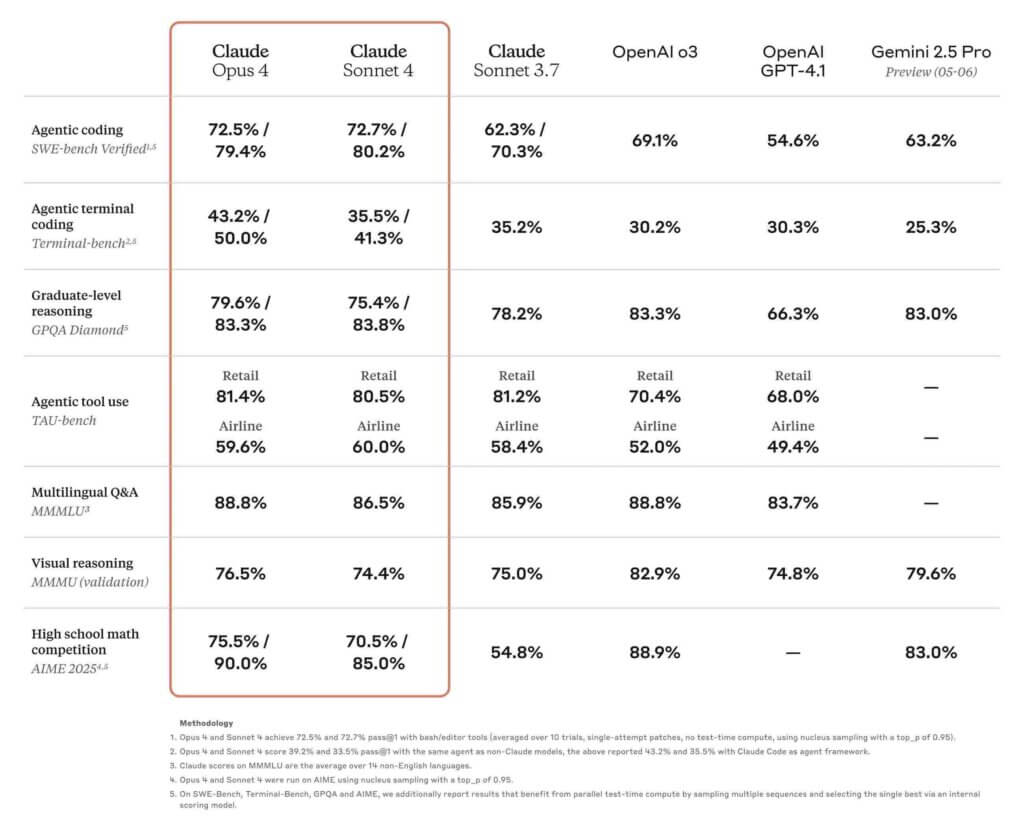
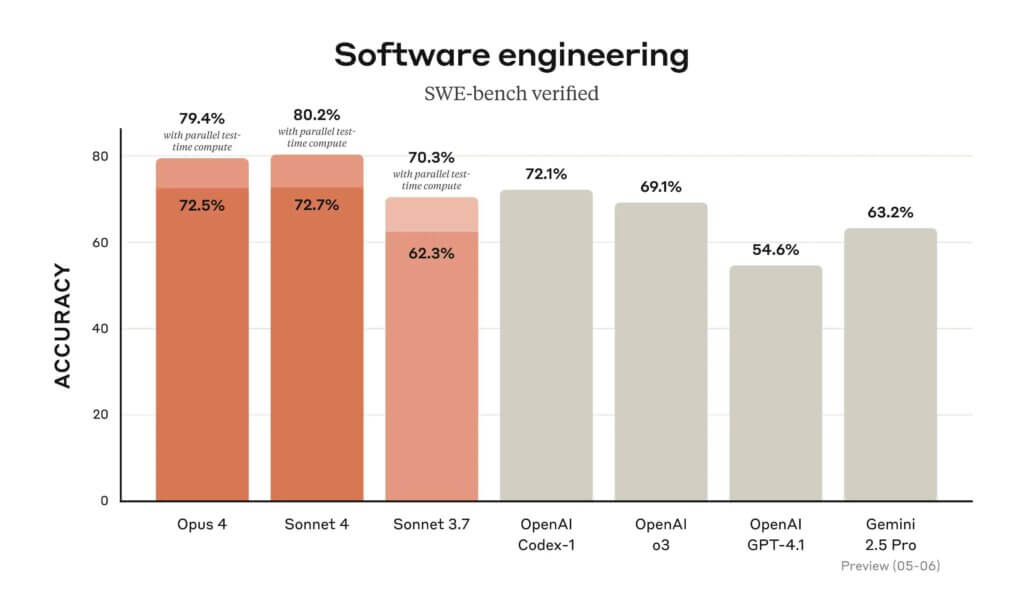
Claude Opus 4 has delivered industry-leading performance in various standardized benchmarks, significantly surpassing its predecessors and competitors:
Claude Opus 4’s consistent benchmark success underscores its unique combination of speed, accuracy, and intelligent reasoning.
| Benchmark | Opus 4 Performance | Comparison to Competitors |
|---|---|---|
| SWE-bench (Software Engineering) | 72.5% (Top score) | Industry-leading, surpassing previous Claude models and other top LLMs |
| Terminal-bench (Coding & Terminal Tasks) | 43.2% (Top score) | Best-in-class for complex command-line interactions |
| MMLU & GPQA (Multidisciplinary Reasoning) | Significant gains over previous models | Exceeds most other reasoning-focused LLMs |
| TAU-bench (AI Agent Tasks) | Exceptional accuracy for long-horizon tasks | Top-tier performance |
Claude Opus 4 Use Cases
Opus 4’s groundbreaking intelligence makes it perfect for tasks far beyond basic text generation. Key use cases include:
1. Advanced AI Agents
Opus 4 powers autonomous AI agents capable of:
- Managing complex business operations.
- Conducting sophisticated market analyses.
- Orchestrating multi-step marketing campaigns across channels.
- Automating extensive workflows in finance, insurance, and legal sectors.
2. Sophisticated Coding and Software Engineering
Ideal for software engineers working on:
- Large-scale refactoring and codebase migrations.
- Multi-file code generation requiring context-aware editing.
- Debugging intricate software issues autonomously.
3. Agentic Search and Deep Research
Perfect for research-intensive tasks:
- Summarizing and extracting insights from lengthy documents or databases.
- Conducting comprehensive patent, academic, or market research independently.
- Supporting strategic decision-making by synthesizing complex data streams.
4. High-Quality Content Creation
Superior performance in:
- Long-form creative writing.
- Technical documentation and tutorials.
- Marketing materials that require natural, human-like prose and detailed explanations.
Pricing for Claude Opus 4
Claude Opus 4 provides transparent, scalable pricing:
| Usage Type | Price per Million Tokens (MTok) |
|---|---|
| Input Tokens | $15 |
| Output Tokens | $75 |
| Prompt Caching (Write) | $18.75 |
| Prompt Caching (Read) | $1.50 |
| Batch Processing | 50% Discount Available |
Claude Opus 4 is available through various platforms:
- Anthropic API
- Amazon Bedrock
- Google Cloud’s Vertex AI

Claude Opus 4: Safety and Security
Anthropic prioritizes AI safety, and Claude Opus 4 has undergone rigorous evaluations to meet high safety and reliability standards, ensuring responsible usage:
- Alignment Testing: Extensive assessments to minimize harmful outputs and biases.
- Transparency: Opus 4 provides visible summaries of its reasoning process, boosting trust and accountability.
- Security Measures: Advanced defenses against prompt injections and malicious misuse.
Frequently Asked Questions about Claude Opus 4
Who should use Claude Opus 4?
Claude Opus 4 is best suited for businesses, researchers, and developers tackling complex tasks needing frontier AI intelligence, including sophisticated coding projects, autonomous AI agents, extensive research, and high-quality content generation.
How is Claude Opus 4 different from Claude Sonnet 4?
Opus 4 is Anthropic’s most powerful and capable model, optimized for complex, long-running tasks. Sonnet 4 provides a balanced mix of efficiency and performance, making it ideal for everyday use cases requiring fast, high-quality outputs.
What are the advantages of the 200K context window?
The expansive 200K token context allows Opus 4 to process extensive inputs seamlessly, maintaining accuracy and coherence over very long interactions or documents, crucial for tasks like comprehensive code reviews, lengthy research papers, or extended conversations.
Can Claude Opus 4 generate images?
No, Claude Opus 4 focuses on advanced reasoning, textual outputs, and coding tasks. It currently does not have image generation capabilities.
How do I get started with Claude Opus 4?
You can access Claude Opus 4 via Claude Pro, Max, Team, Enterprise plans, or through the Anthropic API, Amazon Bedrock, and Google Cloud’s Vertex AI.
Related Claude guides
- Claude Models: Opus, Sonnet & Haiku Explained — full model comparison and use-case guide
- Claude API Cost Estimator — estimate your API costs by model and token volume
- Claude Model Selector — pick the right model for your task
Claude Opus 4 – Our Verdict
Claude Opus 4 represents a monumental advancement in AI technology, redefining what’s possible in artificial intelligence-driven coding, reasoning, and complex problem-solving. Its powerful capabilities, extensive reasoning, and superior performance position it as the leading AI model for tackling sophisticated and demanding tasks across industries.
Whether you’re a business seeking to automate complex processes, a researcher looking for deeper insights, or a developer building next-generation software solutions, Claude Opus 4 offers unmatched capabilities that empower you to achieve groundbreaking results.